THESE ARE THE MOST BEAUTIFUL IMAGES.......................which you could never miss
Sydney Opera House (Australia)
Sydney Opera House (Australia)
The Sydney Opera House is a multi-venue performing arts centre in Sydney, Australia, identified as one of the 20th century's most distinctive buildings.[3]
Designed by Danish architect Jørn Utzon, the building was formally opened on 20 October 1973[4] after a gestation beginning with Utzon's 1957 selection as winner of an international design competition. The government of New South Wales, led by the premier,Joseph Cahill, authorised work to begin in 1958 with Utzon directing construction. The government's decision to build Utzon's design is often overshadowed by circumstances that followed, including cost and scheduling overruns as well as the architect's ultimate resignation.[5]

The building and its surrounds occupy the whole of Bennelong Point in Sydney Harbour, between Sydney Cove and Farm Cove, adjacent to the Sydney central business district and the Royal Botanic Gardens, and close by the Sydney Harbour Bridge.
Though its name suggests a single venue, the building comprises multiple performance venues which together are among the busiest of performing arts centres – hosting well over 1,500 performances annually, attended by more than 1.2 million people.[6] A wide range of performances is presented in the venues, by numerous performing arts producers, including four key resident companies: Opera Australia, The Australian Ballet, the Sydney Theatre Company and the Sydney Symphony Orchestra. As one of the most popular visitor attractions in Australia, more than eight million people visit the site each year, with around 350,000 visitors annually taking a guided tour of the building.[7] The building is managed by the Sydney Opera House Trust, an agency of the New South Wales State Government.
On 28 June 2007, the Sydney Opera House became a UNESCO World Heritage Site.[8]Easter Island (Chile)
Easter Island (Rapa Nui: Rapa Nui, Spanish: Isla de Pascua) is a Chilean island in the southeastern Pacific Ocean, at the southeasternmost point of the Polynesian Triangle. Easter Island is famous for its 887 extant monumental statues, called moai, created by the early Rapa Nui people. In 1995, UNESCO named Easter Island a World Heritage Site, with much of the island protected within Rapa Nui National Park.

Taj Mahal (India)
The Taj Mahal (/ˌtɑːdʒ məˈhɑːl/, more often /ˈtɑːʒ/;[3] Persian for Crown of Palaces[4]) is an ivory-white marble mausoleum on the south bank of the Yamuna river in the Indian city of Agra. It was commissioned in 1632 by the Mughal emperor, Shah Jahan (reigned 1628–1658), to house the tomb of his favorite wife, Mumtaz Mahal. The tomb is the centrepiece of a 42-acre complex, which includes amosque and a guest house, and is set in formal gardens bounded on three sides by a crenellated wall.
Construction of the mausoleum was essentially completed in 1643 but work continued on other phases of the project for another 10 years. The Taj Mahal complex is believed to have been completed in its entirety in 1653 at a cost estimated at the time to be around 32 million rupees, which in 2015 would be approximately 52.8 billion rupees (US$827 million). The construction project employed some 20,000 artisans under the guidance of a board of architects led by the court architect to the emperor, Ustad Ahmad Lahauri.

The Eiffel Tower (France)
The Eiffel Tower (/ˈaɪfəl ˈtaʊər/ eye-fəl towr; French: Tour Eiffel French pronunciation: [tuʁ‿ɛfɛl]  listen) is a wrought iron lattice toweron the Champ de Mars in Paris, France. It is named after the engineer Gustave Eiffel, whose company designed and built the tower.
listen) is a wrought iron lattice toweron the Champ de Mars in Paris, France. It is named after the engineer Gustave Eiffel, whose company designed and built the tower.
Constructed in 1889 as the entrance to the 1889 World's Fair, it was initially criticized by some of France's leading artists and intellectuals for its design, but it has become a global cultural icon of France and one of the most recognisable structures in the world.[3] The Eiffel Tower is the most-visited paid monument in the world; 6.91 million people ascended it in 2015.
The tower is 324 metres (1,063 ft) tall, about the same height as an 81-storey building, and the tallest structure in Paris. Its base is square, measuring 125 metres (410 ft) on each side. During its construction, the Eiffel Tower surpassed the Washington Monumentto become the tallest man-made structure in the world, a title it held for 41 years until the Chrysler Building in New York City was finished in 1930. Due to the addition of a broadcasting aerial at the top of the tower in 1957, it is now taller than the Chrysler Building by 5.2 metres (17 ft). Excluding transmitters, the Eiffel Tower is the second-tallest structure in France after the Millau Viaduct.
The tower has three levels for visitors, with restaurants on the first and second levels. The top level's upper platform is 276 m (906 ft) above the ground – the highest observation deck accessible to the public in the European Union. Tickets can be purchased to ascend by stairs or lift (elevator) to the first and second levels. The climb from ground level to the first level is over 300 steps, as is the climb from the first level to the second. Although there is a staircase to the top level, it is usually only accessible by lift.

Yellowstone National Park (USA)
Yellowstone National Park is a national park located primarily in the U.S. state of Wyoming, although it also extends intoMontana and Idaho. It was established by the U.S. Congress and signed into law by President Ulysses S. Grant on March 1, 1872.[4][5] Yellowstone, the first National Park in the U.S. and widely held to be the first national park in the world,[6] is known for its wildlife and its many geothermal features, especially Old Faithful Geyser, one of the most popular features in the park.[7] It has many types of ecosystems, but the subalpine forest is the most abundant. It is part of the South Central Rockies forestsecoregion.

Great Barrier Reef (Australia)
The Great Barrier Reef is the world's largest coral reef system[1][2] composed of over 2,900 individual reefs[3] and 900 islands stretching for over 2,300 kilometres (1,400 mi) over an area of approximately 344,400 square kilometres (133,000 sq mi).[4][5] The reef is located in the Coral Sea, off the coast of Queensland, Australia.
The Great Barrier Reef can be seen from outer space and is the world's biggest single structure made by living organisms.[6] This reef structure is composed of and built by billions of tiny organisms, known as coral polyps.[7] It supports a wide diversity of life and was selected as a World Heritage Site in 1981.[1][2] CNN labelled it one of the seven natural wonders of the world.[8] The Queensland National Trust named it a state icon of Queensland.[9]

Pyramids of Giza (Egypt)
The Great Pyramid of Giza (also known as the Pyramid of Khufu or the Pyramid of Cheops) is the oldest and largest of the three pyramids in the Giza pyramid complex bordering what is now El Giza, Egypt. It is the oldest of the Seven Wonders of the Ancient World, and the only one to remain largely intact.

Machu Picchu (Peru)
Machu Picchu (in hispanicized spelling, Spanish pronunciation: [ˈmatʃu ˈpiktʃu]) or Machu Pikchu (Quechua machu old, old person, pikchu peak; mountain or prominence with a broad base that ends in sharp peaks,[1] "old peak", pronunciation [ˈmɑtʃu ˈpixtʃu]) is a 15th-century Inca citadel situated on a mountain ridge 2,430 metres (7,970 ft) above sea level,[2][3] located in theCusco Region, Urubamba Province, Machupicchu District in Peru.[4] The site is located above the Sacred Valley, which is 80 kilometres (50 mi) northwest of Cuzco and through which the Urubamba River flows.

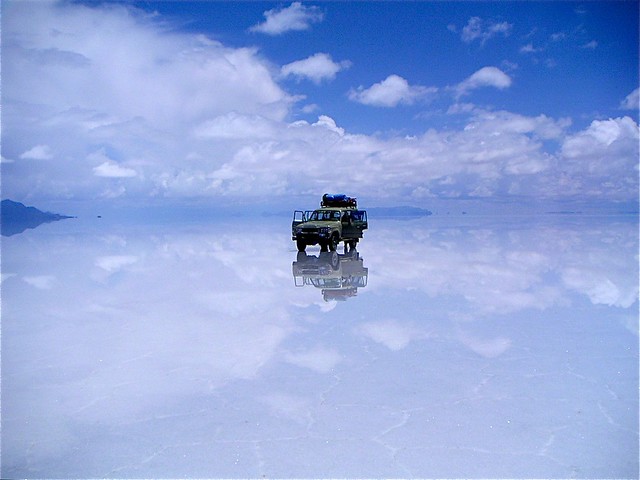
Salar De Uyuni, Bolivia
Salar de Uyuni (or Salar de Tunupa)[1] is the world's largest salt flat at 10,582 square kilometers (4,086 sq mi). It is located in theDaniel Campos Province in Potosí in southwest Bolivia, near the crest of the Andes and is at an elevation of 3,656 meters (11,995 ft) above mean sea level.[2]
The Salar was formed as a result of transformations between several prehistoric lakes. It is covered by a few meters of salt crust, which has an extraordinary flatness with the average altitude variations within one meter over the entire area of the Salar. The crust serves as a source of salt and covers a pool of brine, which is exceptionally rich in lithium. It contains 50 to 70% of the world's lithium reserves,[3] which is in the process of being extracted. The large area, clear skies, and the exceptional flatness of the surface make the Salar an ideal object for calibrating the altimeters of Earth observation satellites.[4][5][6][7][8]
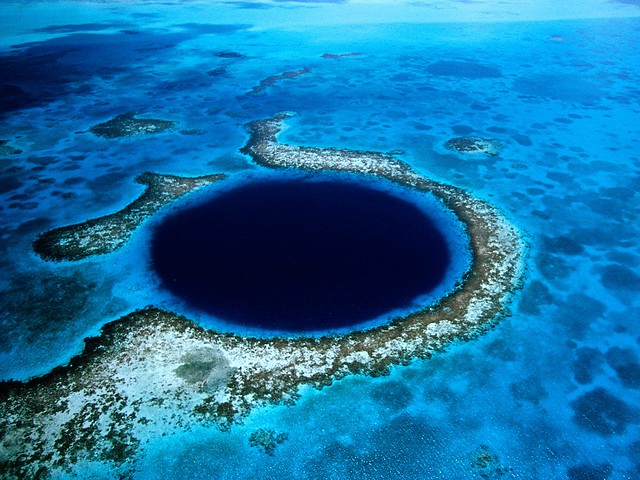
The Great Blue Hole, Belize
The Great Blue Hole is a giant submarine sinkhole off the coast of Belize. It lies near the center of Lighthouse Reef, a small atoll 70 km (43 mi) from the mainland and Belize City. The hole is circular in shape, over 300 m (984 ft) across and 124 m (407 ft) deep.[1] It was formed during several episodes of quaternary glaciation when sea levels were much lower. Analysis of stalactites found in the Great Blue Hole shows that formation took place 153,000; 66,000; 60,000; and 15,000 years ago. As the ocean began to rise again, the cave was flooded.[2] The Great Blue Hole is a part of the larger Belize Barrier Reef Reserve System, a World Heritage Site of the United Nations Educational, Scientific and Cultural Organization (UNESCO).[3]

No comments:
Post a Comment